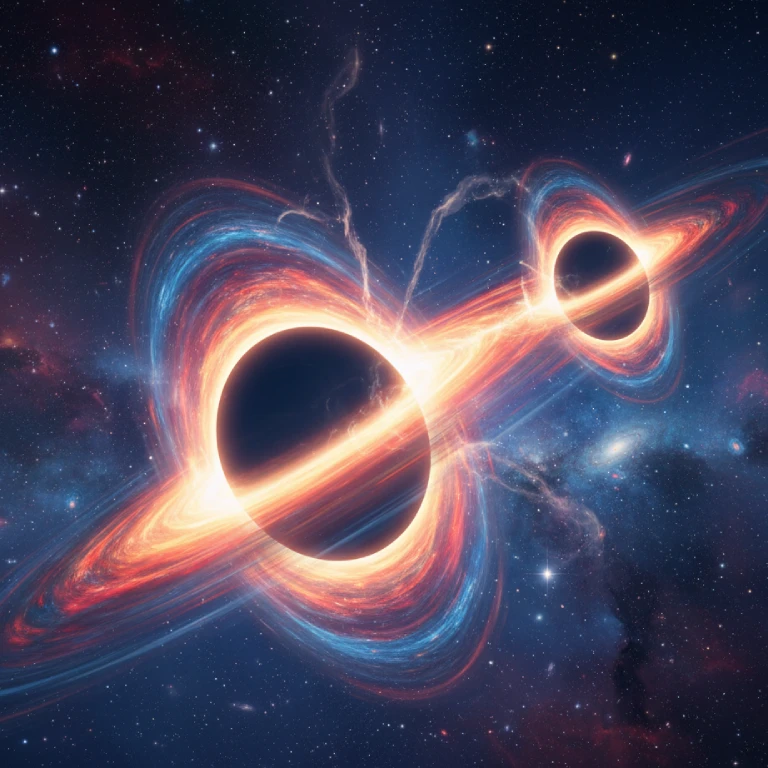
Two black holes can orbit one another, forming what’s known as a binary black hole system. These pairs come in different sizes: stellar-mass binaries, created from the remnants of massive stars, and supermassive binaries, which are thought to form when galaxies merge.
Astronomers long suspected that stellar-mass black hole binaries existed, but they lacked direct evidence. That changed in 2015, when the LIGO observatory made the first detection of gravitational waves—ripples in spacetime—produced by the merger of two stellar-mass black holes. This discovery confirmed both the existence of these binaries and the gravitational waves predicted by Einstein.
Supermassive black hole binaries are expected to form during galaxy collisions, and we see hints of them in certain galaxies, but a clear, direct detection has not yet been achieved. One puzzle is why these giant pairs don’t always merge efficiently. This challenge is known as the “final parsec problem”: at very small separations, the mechanisms that draw the black holes together can become too weak to complete the merger.