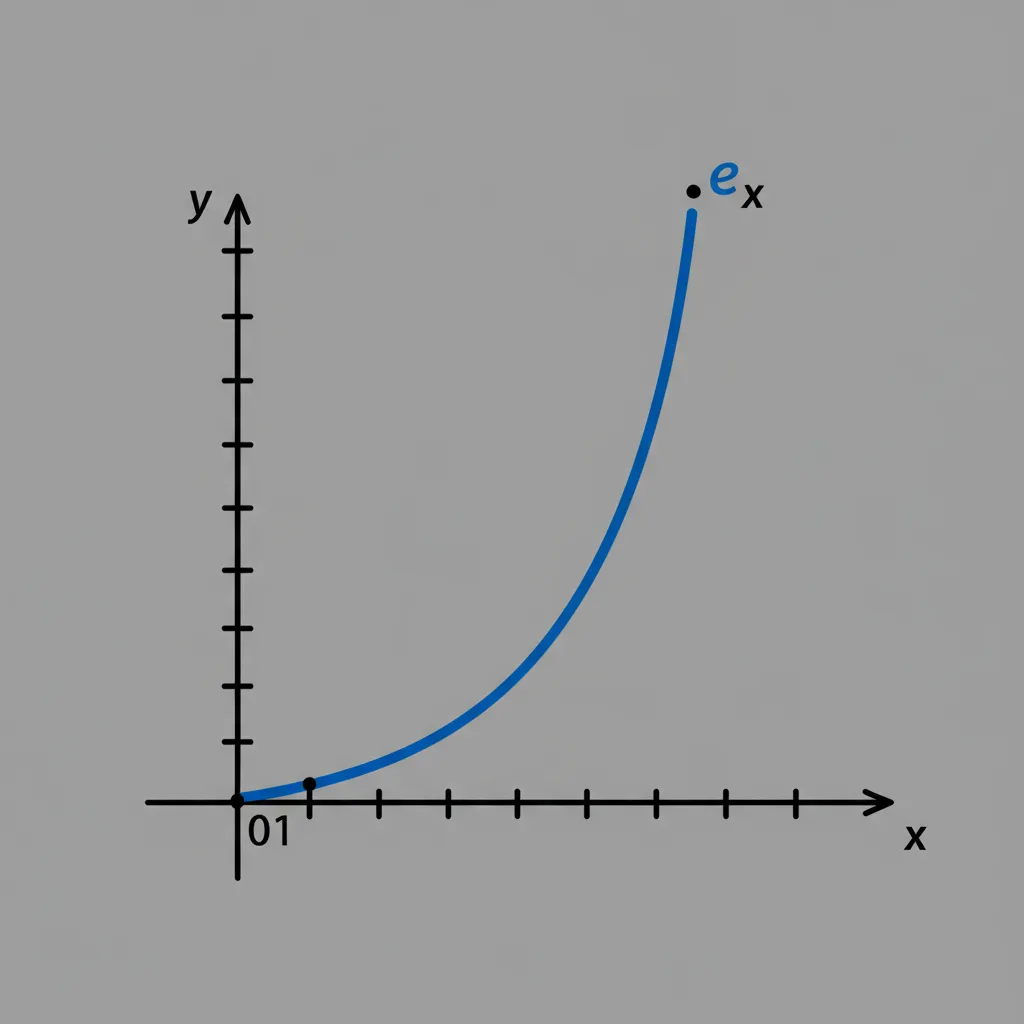
An exponential function is a very important idea in mathematics. It's special because its rate of change is the function itself. It always starts at the value of one when its input is zero. You often see it written as exp(x) or e^x. Here, 'e' is a special mathematical number, about 2.718. This number is sometimes called Euler's number, named after a famous mathematician.
A cool feature is how it changes addition into multiplication. For instance, exp(x+y) is the same as exp(x) multiplied by exp(y). The natural logarithm is its opposite function, turning multiplication back to addition. Other kinds of exponential functions exist, like f(x) = b^x, where 'b' is any fixed number. These functions describe situations where things grow or shrink really fast. Think about how a population grows, or how a disease spreads quickly.
When you graph an exponential function, it always slopes upwards and gets super steep. The graph always stays above the x-axis, getting closer to it for very negative inputs. This powerful function can even work with complex numbers, linking them to rotations and angles. This connection is made through a famous rule called Euler's formula.