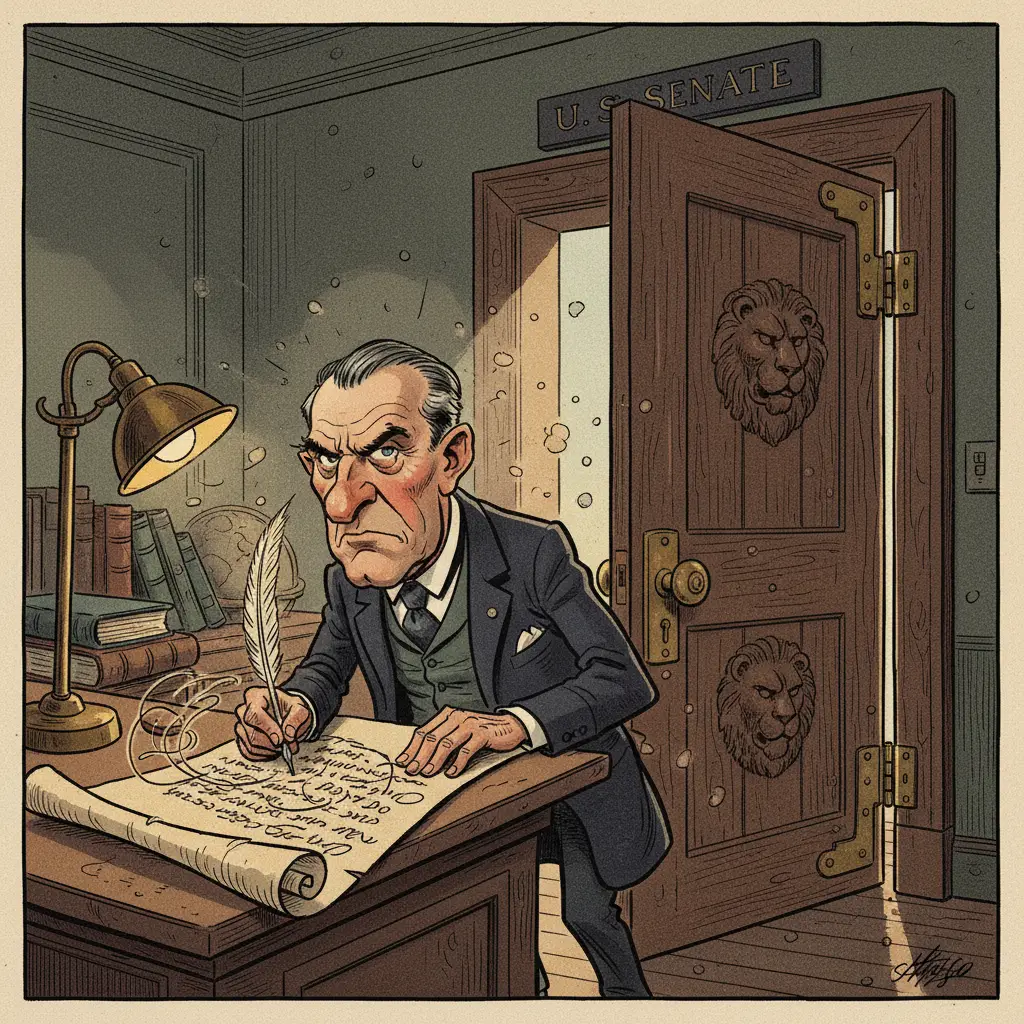
Henry Cabot Lodge, a U.S. Senator, proposed fourteen special conditions, called "reservations," for the Treaty of Versailles after World War I. This treaty aimed to create a League of Nations, an international group meant to prevent future big wars. However, the League's plan, mostly written by President Woodrow Wilson, allowed the League to decide when to go to war, meaning all member countries would have to join.
Senator Lodge felt it was important for the United States to join the League, but only if these conditions were added. His main goal was to make sure the U.S. kept its power and that Congress, not an international body, would decide if the country went to war. The Democrats, following President Wilson's lead, refused to accept Lodge's reservations, and Republicans wouldn't agree to join without them.
In the end, the U.S. Senate voted against the Treaty of Versailles in 1919, so the United States never became a member of the League of Nations. This decision showed a strong desire to avoid being pulled into international conflicts without full control. Interestingly, many of Lodge's ideas for protecting a country's independence later helped shape the United Nations when it was created in 1945, giving the U.S. important powers like the right to veto decisions.
To give you an idea of his concerns, some of Lodge's reservations said that the U.S. should be the only one to decide if it wanted to leave the League. Another important point was that the U.S. shouldn't be forced to defend other countries or get involved in their problems unless Congress specifically declared war. He also believed that the U.S. alone should interpret its own long-standing policies, like the Monroe Doctrine, and that Congress should approve any U.S. representatives or money contributed to the League.