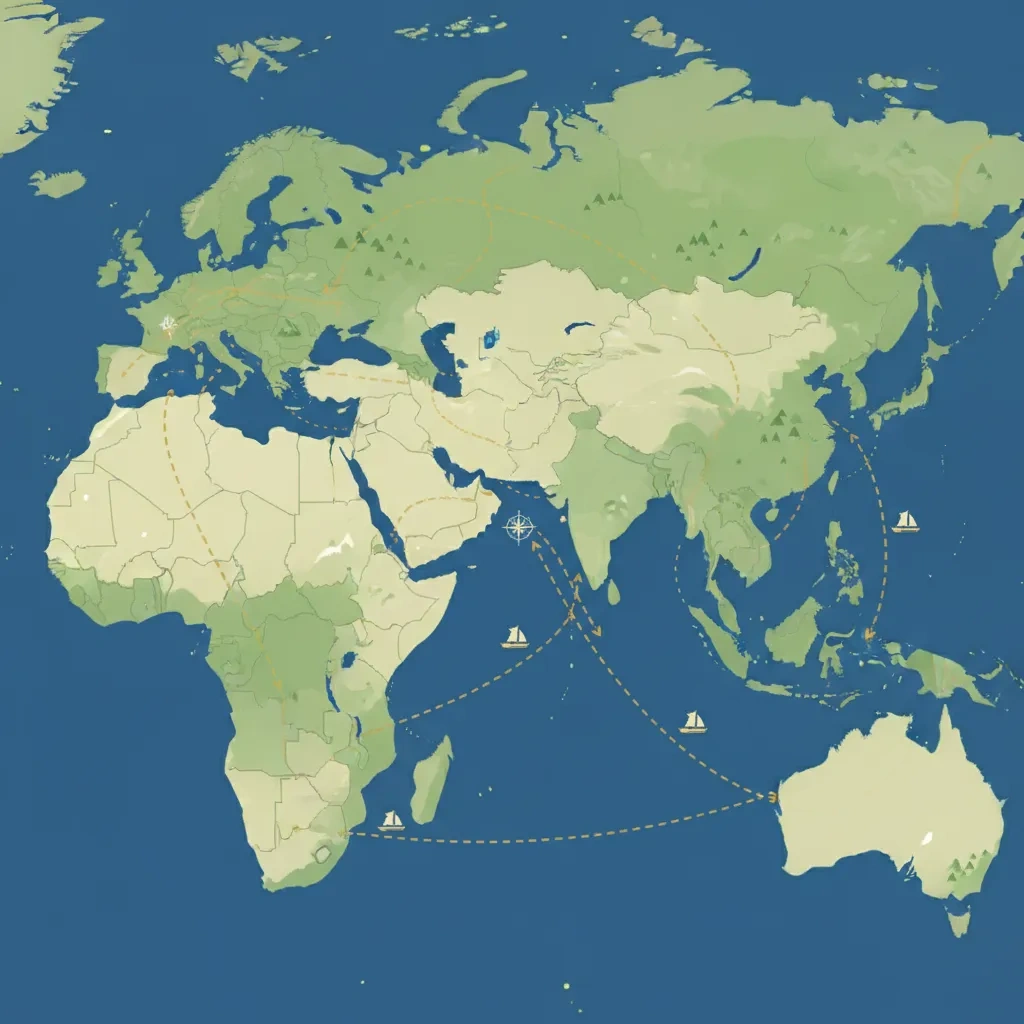
The Maritime Silk Road was a super important sea route that connected many parts of the world, like Southeast Asia, India, Africa, and Europe. It operated for a long time, from around 200 BCE all the way to the 15th century CE. Austronesian sailors from Southeast Asia were the main people who started and used these routes with their special ships, with Persian, Arab, Tamil traders, and China joining later.
This sea network actually grew from much older trading paths. Thousands of years ago, people in Southeast Asia traded beautiful jade from Taiwan, creating a huge network around the South China Sea. They also traded spices like nutmeg and cloves with places like Sri Lanka and South India, even bringing new crops and cool sailing boats. Meanwhile, in West Asia, people traded along the coasts for even longer, since about 5000 BCE.
Eventually, these ancient paths all connected up around 200 BCE, forming the big Maritime Silk Road. Goods from as far as China and Southeast Asia could be exchanged with places in Europe and East Africa. Powerful Austronesian kingdoms controlled key areas, especially around busy straits, ensuring smooth trade. These routes were also very important for spreading religions like Hinduism and Buddhism to new lands, with Sanskrit becoming a common language for traders, and even Chinese pilgrims used these ships. By the 7th century, Arab traders began using these routes, helping to spread Islam. Later, from the 10th to 13th centuries, China started building its own large trading ships and encouraged more sea trade, which really made the Maritime Silk Road boom.