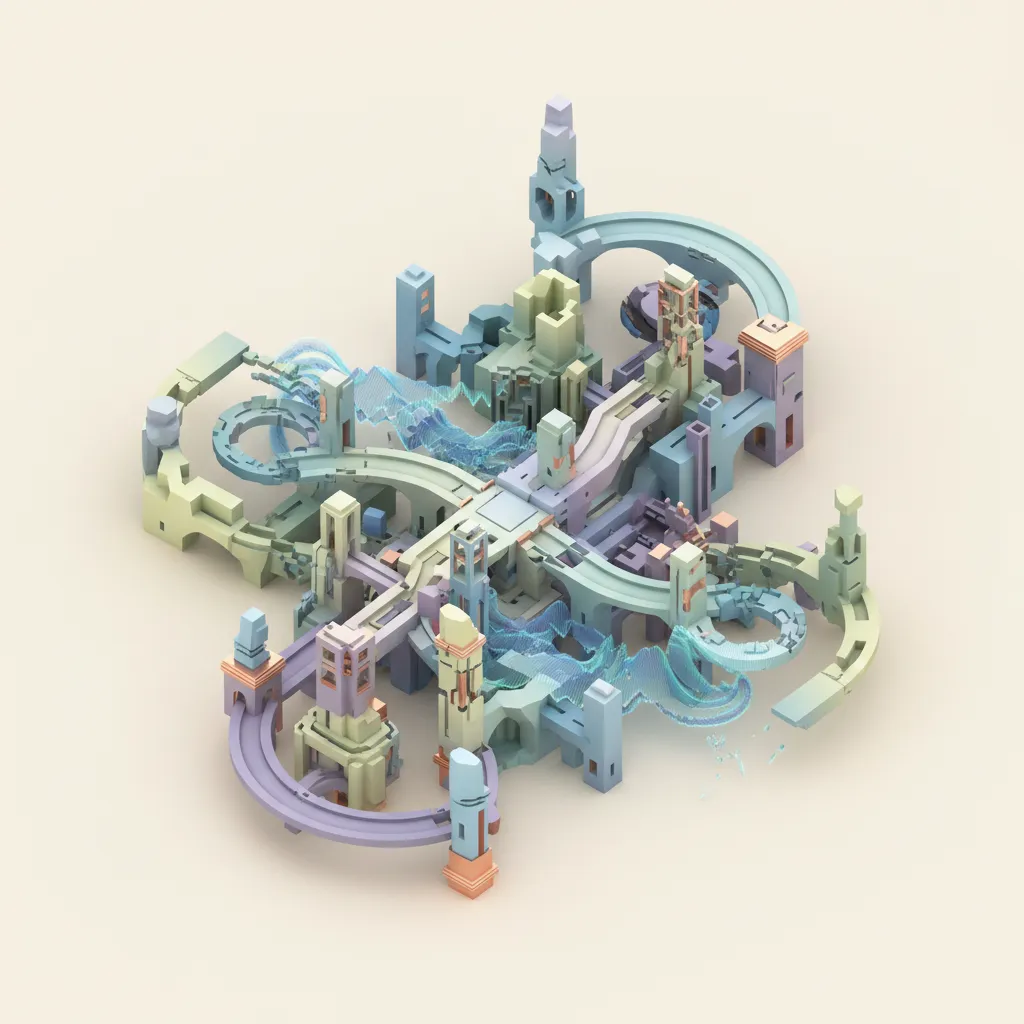
There's a cool type of computer algorithm called 'model synthesis' or 'wave function collapse' that helps make game worlds and other things automatically. It's often used in video games like Bad North and Townscaper to create unique landscapes or buildings. Paul Merrell first described this idea as 'model synthesis' way back in 2007. Later, in 2016, Maxim Gumin made a similar version popular online, and people started calling it 'wave function collapse' because it reminded them of how tiny particles behave in quantum physics. Gumin's approach became very well-known among game developers and artists.
Imagine the algorithm starting with a blank canvas where every spot, or 'cell,' could be many different things, like a tree, a road, or water. It then picks a spot and decides what it should be, like "collapsing" all possibilities into one definite choice, always trying to pick the spot with the fewest options first. After that, it makes sure all the surrounding spots still make sense with the new choice, like making sure a road doesn't suddenly end in the middle of a lake. Paul Merrell's original idea worked similarly but often processed spots in a line instead of picking the one with the fewest options. His method also worked in chunks, which was great for creating large 3D environments, though sometimes a line-by-line approach could leave little patterns or 'artifacts.'
More recently, smart people have improved these algorithms to handle more complex designs, like creating an entire castle first and then filling in its specific walls and rooms. This means the computer can think about bigger ideas before filling in all the small details, making it even more powerful for generating amazing virtual worlds.