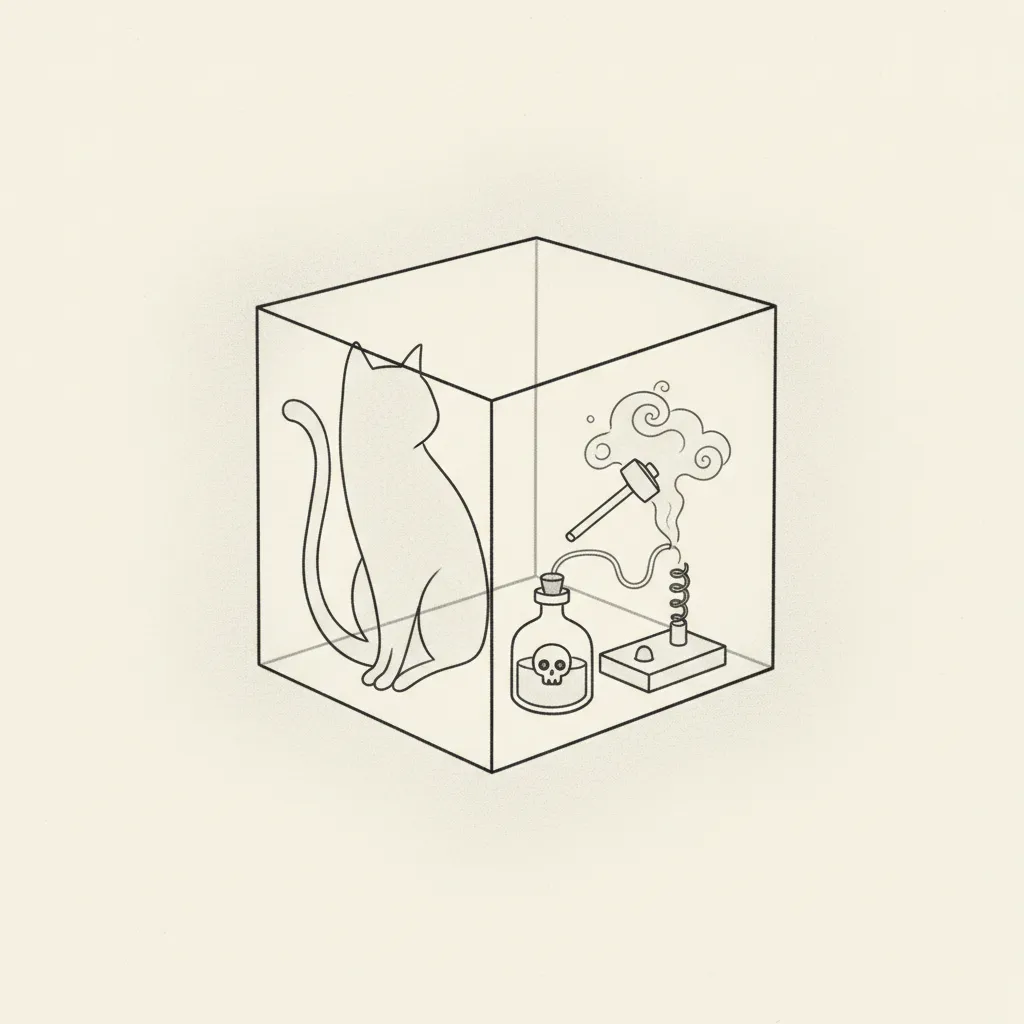
Schrödinger's cat is a famous thought experiment in physics that explores quantum superposition, a tricky idea where something can be in multiple states at once. Imagine a cat inside a sealed box, linked to a device with a tiny bit of radioactive material. If this material decays, poison is released, and the cat dies. If it doesn't decay, the cat lives.
The puzzling part is that, according to the rules of quantum physics, until someone looks inside the box, the cat is thought to be both alive and dead at the same time. This seems impossible in our everyday world, but it's what happens with super tiny particles. However, when you finally open the box, you only ever see the cat either fully alive or fully dead, never both.
Physicist Erwin Schrödinger came up with this idea in 1935, discussing it with Albert Einstein. He wanted to highlight how strange it would be if the quantum rules for tiny atoms applied directly to big things like cats. The experiment helps scientists discuss when exactly a quantum "superposition" ends and becomes a single, definite reality. It's not meant to be a real experiment with an actual cat, but a simple way to think about complex atomic behavior. Scientists have developed many different interpretations to explain this paradox. Some, like Niels Bohr, believed the cat's state was simply undetermined until observed, without needing a human to make it so.